12  Syncope

12.1 Note

12.1.1 H&P

*** Denied HA, diaphoresis, n/v, cold or warm sensation, CP, SOB, palpitations, deja vu, jamais vu, blurry vision or lightheadedness prior to the episode. No witnessed cyanosis while unconscious, tongue bite/laceration, incontinence, limb twitching or seizure-like activity. Following the episode, the pt was not confused and had normal/baseline mentation.

12.1.2 A&P

Syncope
- Calgary Score (VVS)
    - ≥ -2 suggests vasovagal syncope
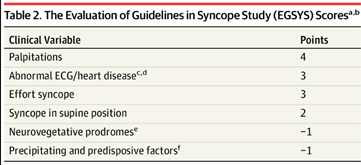
- EGSYS score
    - < 3 makes cardiac syncope *less* likely
- History: prodromal Sx? dehydration? infectious Sx? deconditioning/malnutrition?
- Medication review: *** anti-HTNs, diuretics, vasodilators, antipsychotics, anti-depressants, EtOH, opiates
- Labs:
    - beta-HCG (if +, consider ectopic pregnancy)
    - Trop, BNP (if indicated)
- EKG
    - try to exclude BLOWHard conditions
- TTE
- Telemetry
  - Outpatient: consider mobile cardiac outpatient telemetry (MCOT)
- Orthostatics
- Any concerning features to suggest adrenal insufficiency?
- Consider autonomics consult if indicated
- PT/OT
- Consider home safety evaluation
Orthostatic hypotension
- Encouraged to rise from resting position gradually, avoid standing motionless (even if still, tense leg mm.)
- Compression waist high stocking (30-40 mmHg)
- Abdominal binder
- Increase salt consumption 6-10 g/d
- Encouraged water intake 2-3 L/d
- If Sx persist despite the above interventions, consider fludrocortisone
    - Alternative pharmacotherapy: midodrine

12.2 4 General Causes

  • Reflex-mediated
    • Vasovagal (most common cause)
    • Situational, e.g. coughing, micturition, etc.
    • Carotid sinus hypersentivity
  • Cardiac
    • arrhythmia, e.g. SSS, VT, AV block, etc.
    • obstruction, e.g. severe AS, HCM, PE, etc.
    • massive MI
  • Orthostatic
    • intravascular volume depletion (e.g. dehydration, blood loss) vs. abnml autonomic reflexes
  • Neuro
    • Central → brain steam lesions, Parkinson disease, Lewy body dementia, Parkinsonism, Shy-Drager syndrome
    • Peripheral → pure autonomic failure, diabetic neuropathy
Seizure-like activity with Syncope

Pts w/ LOC d/t syncope can have brief (< 15 seconds) of brief asymmetric or symmetric myoclonic or tonic-clonic movements (not a seizure!). Typically occurs within 10 seconds after LOC, but not before.
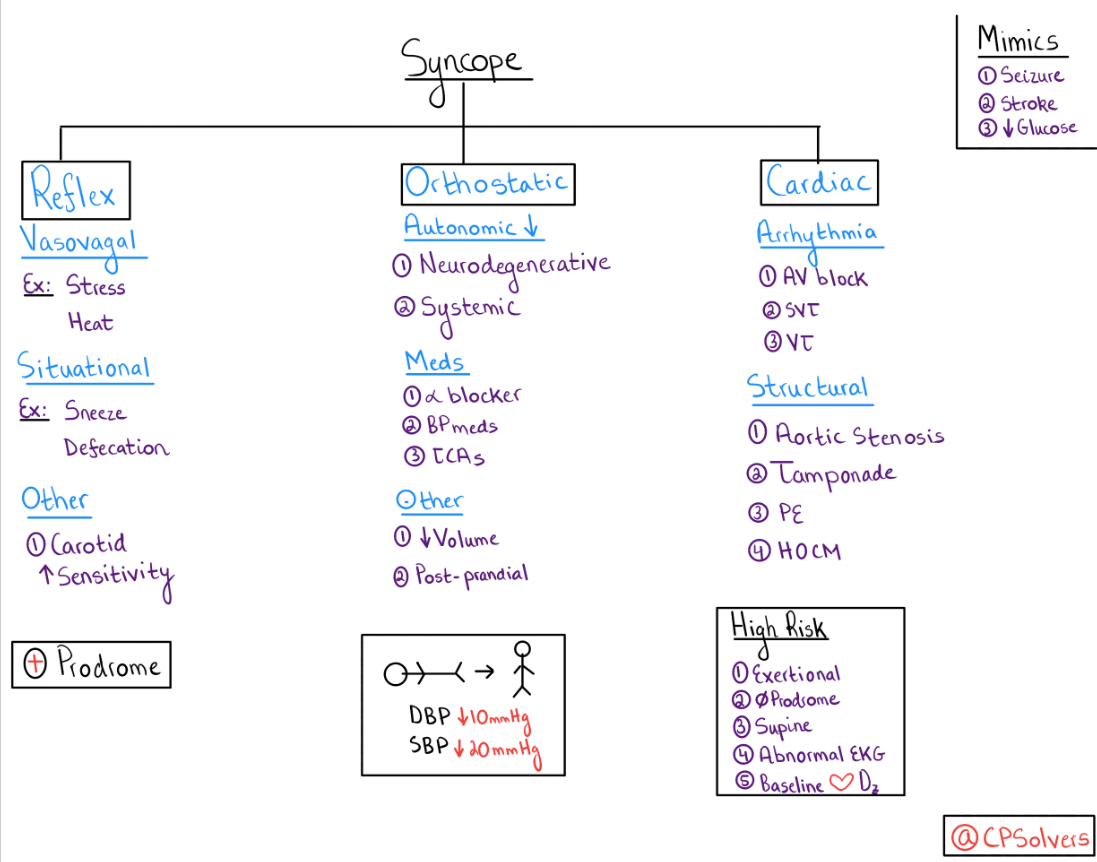
CPS Syncope Schema

12.3 Mimics

  • Seizures
    • History:
      • head turning during the event (seizure > syncope; +LR for seizure 14)
      • unusual posturing during the event (seizure > syncope; +LR 13)
      • urinary incontinence (+LR 6.7)
      • absence of presyncope (+LR 5.6)
    • Exam:
      • tongue laceration (+LR 16)
      • no recall of unusual behaviors before LOC (+LR 4)

flowchart TD
    A[LOC episode] --> B(Prolonged Confusion)
    A --> C(Rapidly regain awareness)
    B -->D[Seizure<br>post-ictal confusion]
    C -->E[Syncope]
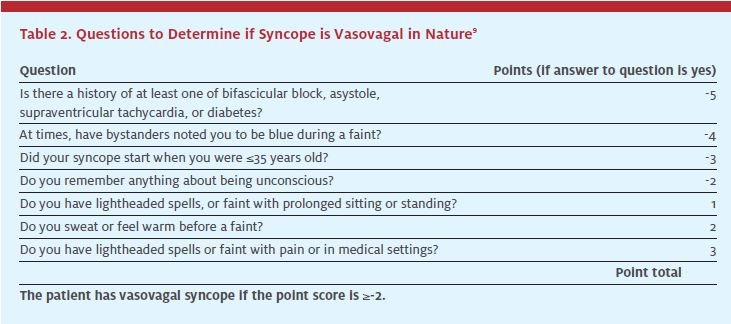
Figure 12.1: Time to regain of consciousness/awareness after an LOC episode can be useful to differentiate seizures (post-ictal confusion) and syncope.

  • Stroke
  • hypOglycemia
  • Rare
    • subclavian steal syndrome
    • vertebrobasilar TIA
    • SAH

12.4 Reflex-mediated Syncope

  • Common precipitants:
    • pain/emotion/fear
    • warm/hot environment
    • afferent visceral stimuli, e.g. distended stomach or bladder
    • pressure on carotid sinus baroreceptor, e.g. a tight collared shirt while turning the neck
  • Prodromal Sx
    • Cause: efferent vagal component of the reflex leads to autonomic symptoms
    • History: HA, sweating, a sense of cold or warmth, n/v, abdominal discomfort, or urge to defecate
  • Vasovagal syncope
    • usually initiated by prolonged sitting or standing → ~ 500-800 mL of blood remains in the distensible vv. below the ♥

12.4.1 Vasovagal Syncope Score (Calgary Score)

  • Vasovagal syncope is suggested if score ≥ -2

Grading for Vasovagal Syncope Score (Calgary Score)

12.5 Cardiac Syncope

  • Etiology: a marked ↓ in CO due to cardiopulmonary disease, such as arrhythmia, structural heart disease, or PE → cerebral hypOperfusion
  • History
    • may occur at rest, in the supine position, or during effort when the pt is unable to ↑ CO to meet the increased demand
    • may be preceded by CP, SOB, or palpitations
    • may have witnessed cyanosis while unconscious

12.5.1 EGSYS Score

  • Score range: -2 to 12
  • Higher score → ↑ likelihood of cardiac syncope
  • EGSYS < 3, suggests low likelihood of cardiac syncope

Grading for EGSYS Score

12.5.2 Things to rule-out on ECG

4 cardiac conditions to look for on ECG in all patients presenting with syncope (BLOWHard) Source:

  • Brugada
  • LOng QT
  • WPW
  • HCM/LVH

12.5.3 Orthostatic hypOtension

  • Great overview on orthostatic hypotension
  • Performing orthostatics
    • baseline: check BP, HR after pt lying down for at least 5 minutes
    • after 1 minute of standing
    • after 3 minutes of standing
  • Interpreting orthostatics
    • positive for orthostasis if ↓ SBP of of ≥ 20 mmHg or ↓ DBP of ≥ 10 mmHg
      • for HTN pts, a ↓ of SBP ≥ 30 mmHg may be a more appropriate criteria 1
    • HR response
      • if HR ↑ by < 15 bpm after standing → suggests neurogenic orthostatic hypOtension
      • if HR ↑ by > 20 bpm after standing → suggests volume depletion
      • if HR ↑ by > 30 bpm after standing → suggests postural orthostatic tachycardia syndrome (POTS)
        • POTS usually presents with typical orthstatic Sx, but do not meet BP criteria for orthostasis, i.e. little/no ↓ in BP w/ postural ∆

12.6 Clinical Pearls

  • In a pt presenting with syncope and elevated \(\beta\)-hCG, think about ectopic pregnancy as possible underlying cause
  • In a pt presenting with syncope and associated severe HA, think about SAH or intracranial hemorrhage
  • In a pt presenting with syncope and neuro deficits, think about stroke/TIA or intracranial bleed
  • In a young pt presenting with syncope during exercise, think about anomalous coronary artery
    • normally, folks will complain of syncope after exercise
  • Orthostatic hypOtension causes the postural instability in pts w/ Parkinsonism
  • Shy-Drager syndrome: Parkinsonism predominantly w/ orthostasis

  1. Freeman R, Wieling W, Axelrod FB, et al. Consensus statement on the definition of orthostatic hypotension, neurally mediated syncope and the postural tachycardia syndrome. Clin Auton Res. 2011;21(2):69-72. doi:10.1007/s10286-011-0119-5↩︎