graph TD
    A[Acute Chest Pain<br>ED Evaluation] --> B(12-lead ECG)
    B --> C[Normal/ST-T changes, but No STE]
    B --> D[ST Elevation]
    D --> E(Active STEMI Protocol)
    C --> F(Tn-<br>Unstable Angina)
    C --> G(Tn+<br>NSTEMI)
graph TD
A[Acute Chest Pain<br>ED Evaluation] --> B(12-lead ECG)
B --> C[Normal/ST-T changes, but No STE]
B --> D[ST Elevation]
D --> E(Active STEMI Protocol)
C --> F(Tn-<br>Unstable Angina)
C --> G(Tn+<br>NSTEMI)
*** UA/NSTEMI
    - BMP, CBC
    - A1c
    - Lipids
    - TSH w/ reflex
- Treatment
    - ASA 162/325 (if indicated)
    - Heparin gtt (per ACS protocol)
    - BB
    - Nitrates (SLN, paste?)
    - Other anti-anginal: CCB (if unable to tolerate BB), nitrates (long-acting if refractory to BB), ranolazine (adjunct to BB)
    - Anti-platelet: ASA +/- clopidogrel
    - Statin
    - Optimize BP control, e.g. ACEi/ARB
    - Optimize glycemic control in pts w/ DM
    - Nicotine replacement therapy (if indicated)
- Lifestyle modifications
    - Smoking cessation
    - Exercise
    - Weight loss
- Supplemental O2 PRN
- Diet: low fat, low cholesterolTODO
💡Response to nitroglycerin should not be used as a diagnostic test in the evaluation of chest pain.
Assuming a base rate of 15%, i.e. pre-test probability of 15%.
| Feature or Finding | LR+ | Post-test Probability |
|---|---|---|
| Radiation to both arms | 9.7 | 63% |
| Radiation to right arm | 7.3 | 56% |
| Third heart sound | 3.2 | 36% |
| Hypotension | 3.1 | 35% |
| Radiation to left arm | 2.2 | 28% |
| Radiation to right shoulder | 2.2 | 28% |
| Crackles | 2.1 | 27% |
| Diaphoresis | 2.0 | 26% |
| Nausea and vomiting | 1.9 | 25% |
Patients with kidney disease often have elevated troponin levels raising the risk of false-positive tests for MI.
Although AV block is more common with inferior MIs. If it does occur with anterior MI, it is due to destruction of a large amount of myocardium in the interventricular septum. ∴ AV block in setting of an anterior MI is associated with higher mortality than AV block in setting of inferior MI (transiet, no ppm required). AV block due to anterior MI requires pacemaker placement.
| Management | Indications |
|---|---|
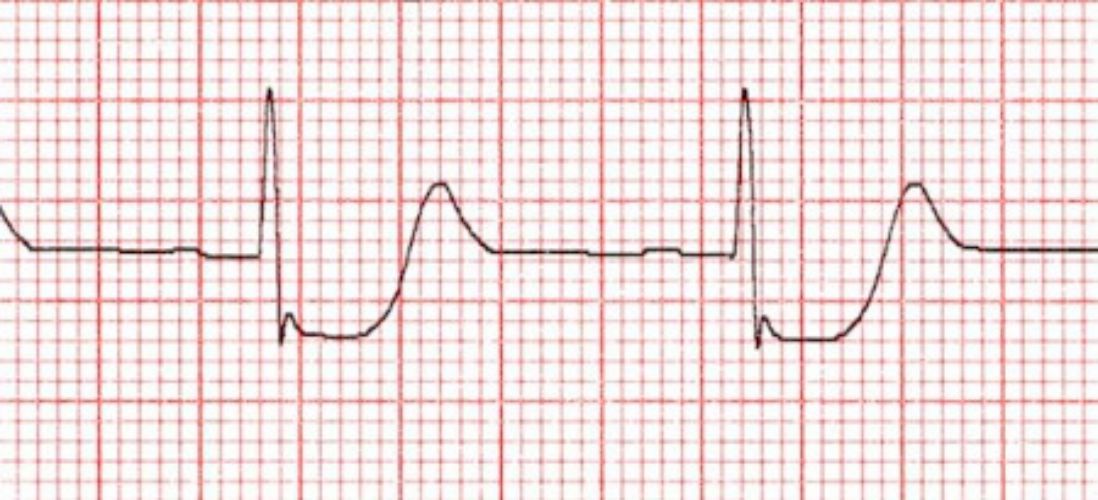
| Cath lab ASAP | STEMI NSTEMI unstable/cardiogenic shock severe LV dysfunction recurrent/persistent angina at rest despite intensive medical therapy new/worsening MR or VSD sustained ventricular arrhythmia |
| Cath lab within 24 hrs | NSTEMI/UA TIMI: intermediate (3-4) or high (5-7) risk |
| Cath lab prior to discharge | NSTEMI/UA TIMI: low (1-2) risk and (+) EKG changes or ↑ Troponin |
| Medical management | NSTEMI/UA Stable and TIMI: low (1-2) risk |
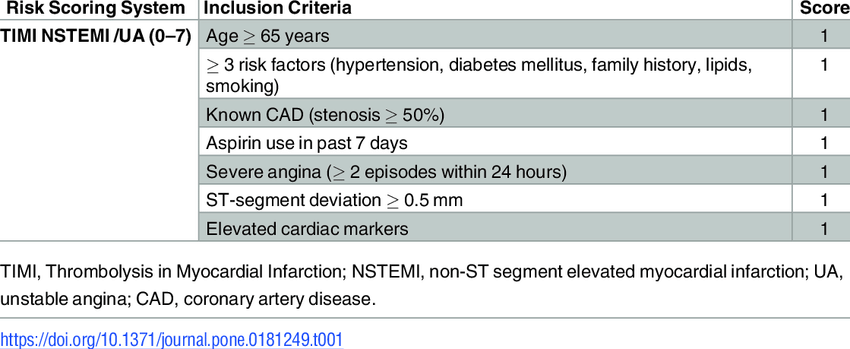
Historically, a “new” left bundle branch block (LBBB) in the setting of chest pain was to be treated like a STEMI. Recent studies demonstrate that most patients with chest pain and a “new” LBBB do not have a STEMI (Jain et al., 2011; Kontos et al., 2011). (Source)
If a patient has taken a PDE-5 inhibitor, e.g. viagra, you should wait 24 hrs before giving nitroglycerin
Complete revascularization is superior to culprit-only revac for the primary endpoint of CV death and MI.(Mehta et al. 2019) Of note, these patients were NOT in shock.
Revascularization of the non-culprit lesions need not occur at the time as primary PCI (revascularization of the culprit lesion(s)). In other words, can use a staged revascularization strategy.
Optimal timing of staged procedure unclear
In the COMPLETE trial, complete revascularization was not performed at index Primary PCI
For patients who present in cardiogenic shock (See Chapter 42), mortality was lower among those who had culprit-only PCI rather than immediate (not staged) multivessel PCI. (Thiele et al. 2017)
Any potential advantage of multivessel PCI is outweighed by mortality hazard of the initial longer procedure.
Main proven goal in shock is rapid and complete reperfusion of culprit vessel
If expecting delay, i.e. first medical contact to primary PCI >120 min
Pharmaco-invasive strategy
Full dose lysis, heparin, clopidogrel (loading dose) and
Send to PCI-capable hospital for routine PCI
Outcomes equivalent to and safe as primary PCI
CAPTIM (Bonnefoy et al. 2009; Steg et al. 2003)
WEST (P. W. Armstrong 2006)
Fast MI registry (Danchin et al. 2008)
STREAM (Paul W. Armstrong et al. 2013)
Look for evidence of successful reperfusion after 90-120 mins of getting lytics
looking for STE resolution, specifically >50% resolution in initial ECG of lead with maximum STE
If no STE resolution, considered to have failed lytic therapy → go urgently to cath lab
If STE resolution, then responded to lytics → go to cath lab 3-24 hrs after getting lytics for revasc
Sx bradyarrythmia refractory to meds
asystole or sinus arrest
complete (3rd degree) AV block
Mobitz type 2 (2nd degree) AV block
antiplatelet therapy
high-intensity statin
β-blockers (if LVEF < 40% or prior MI)
ACEi
Order an Echo after a STEMI to evaluate for cardiac function (e.g. EF) and mechanical complications
The most important prognostic factor in pts w/ CAD is the degree of LV dysfunction
Left main CAD w/ > 50% stenosis
3-vessel CAD with > 70% stenosis in each vessel
significant (> 70% stenosis) in 2-vessels with 1 of these 2 vessels being the proximal LAD [Left main equivalent]
CABG vessel patency at 10 yrs:
internal mammary artery (IMA) graft: 90% are patent at 10 yrs
saphenous vein: 50% are patent at 10 yrs